Metal powder laboratory and quality control · melting, atomizing, measurement
Metal powder testing laboratory
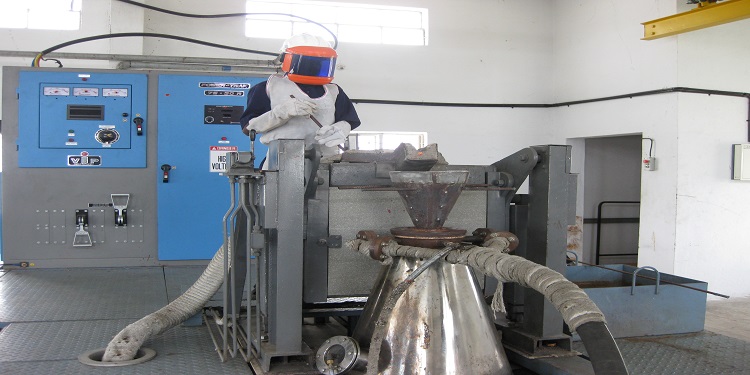
Sanwa Metal Powders melts, atomizes and tests its powders in one place: a high-frequency induction furnace by Inductotherm (USA), an inert gas atomizer built entirely of stainless steel, and a laboratory equipped for chemistry, sieve analysis, density, flow rate and microscopy.
- Melting
- High-frequency induction furnace, Inductotherm (USA)
- Atomizing
- Inert gas atomizer, built entirely of stainless steel, with a powder recovery system
- Routes
- Gas atomized and water atomized
- Certification
- ISO 9001:2015
Quality is controlled from raw-material procurement to the finished powder.
Melting and atomizing
Every powder starts as a melt and is then gas or water atomized.
The charge is melted in a high-frequency induction melting furnace by Inductotherm, USA. The melt is then atomized: broken into droplets that freeze into powder.
The inert gas atomizer is built entirely of stainless steel and has a powder recovery system. Sanwa was the first company in India to make gas-atomized powders, and we make both gas-atomized and water-atomized grades.
Each grade table gives the particle shape: irregular, spherical or globular.
The two routes
Bronze, pre-alloyed and pure metal powders are water and gas atomized. Cobalt-chromium is gas atomized. Stainless steel is gas and water atomized.
What we measure
The laboratory is equipped for six tests. Here is what each one tells you about a powder.
- Chemical composition
- The complete chemistry of the powder.
- It is what a grade is: the Sn, Cu, Co, Cr, W, C and Fe figures printed in the grade tables.
- Sieve analysis
- The particle size distribution, measured by sieve.
- Whether the powder passes the mesh your process is built around, and how much of it sits in each size band.
- Apparent density
- The mass of a fixed volume of loose, unsettled powder.
- How much powder a die cavity holds at fill, so it governs the fill depth your tooling needs.
- Flow rate
- The time a fixed mass takes to flow through a standard funnel.
- Whether the powder will fill a die evenly and repeatably. A powder that hangs up fills unevenly.
- Bulk density
- The mass of a fixed volume of powder as it is handled and packed.
- How a 5 kg or 25 kg pack fills, and how the powder settles in transit.
- Microscopy
- Particle shape and microstructure under the microscope.
- Shape is the column the tables call irregular, spherical or globular; microstructure shows how the droplet froze.
The grade tables publish the composition and particle size of all 29 grades. Ask for apparent density, flow rate or bulk density against the grade you need.
Particle size by sieve
Eleven of the 29 grades are specified by mesh. Ten are −325# or 325#; SMBr9010/G is −120/300#.
The other eighteen grades
Three pre-alloyed grades are specified in micrometres: SM56 at 10 µm, SM61 at 8–10 µm and SMP10 at 8 µm. The 15 cobalt-chromium and stainless steel grades are specified as −180/50 µm and −150/50 µm.
Quality, from raw material to finished powder
Quality is controlled at every stage of production, from the procurement of raw material to the finished powder.
Sanwa Metal Powders is an ISO 9001:2015 certified company, and has been making metal powders for more than 30 years. The powders go to industries across India, and Sanwa Diamond Tools uses them in its own diamond-tool segments.
The team
The laboratory and the plant are run by a team of technically qualified powder metallurgists and engineers, working across production, maintenance, quality control and service.
If no grade in the table is quite right, send the chemistry and the particle size and the team will tell you what they can make.
Where they work
- Production
- Maintenance
- Quality control
- Service
A division of Sanwa Diamond Tools Pvt. Ltd. · About Sanwa Metal Powders
Tell us what you need
Send us the grade, or the chemistry.
Quote, sample or a composition of your own. Monday to Saturday, 9.30 am to 6.00 pm.
- Phone
- +91 94482 80400
- info@metalpowders.in